Vietnamese lotus tea is green tea that has taken on the scent of fresh lotus flowers, with no flavouring added. At TRAVINA – Tâm Trà Việt Cooperative we grow and make the base tea in Đại Từ – La Bằng, Thai Nguyen, and scent it with Bách Diệp lotus from West Lake (Tây Hồ) in Hanoi during the short flowering season, roughly May to July. We make it two ways: Trà Sen Tây Hồ (West Lake Lotus Tea), where tea is sealed inside a whole flower, and Trà Gạo Sen Bách Diệp Tây Hồ (West Lake Lotus Rice Tea), where needle-grade tea is layered again and again with “lotus rice”, the anther tips picked from each flower, then sieved clean. Because the flowers only exist for a few weeks a year, lotus tea is a seasonal product with a hard ceiling on volume. The earlier you book, the more we can set aside for you.
| What importers ask | Short answer |
|---|---|
| Base tea | Hand-picked Thai Nguyen green tea from our own gardens in Đại Từ – La Bằng |
| Lotus | Bách Diệp (hundred-petal) lotus from West Lake ponds in Tây Hồ, Hanoi. We buy the flowers each season; we do not grow them |
| Two styles | Whole-flower scenting (Trà Sen Tây Hồ) and lotus-rice scenting (Trà Gạo Sen Bách Diệp Tây Hồ) |
| Season | Fresh scenting only while the lotus blooms, roughly May to July, with the peak around June |
| Packs | Single flowers in gift boxes, a 5-flower gift set, and a 100 g tin or single-brew sachets for the lotus-rice tea; other formats on request |
| Shelf life | Printed on each pack and confirmed on the pro-forma invoice |
| MOQ and price | No fixed MOQ; it is set against the season’s output. Quotes are EXW in USD, on request |
| Documents | VietGAP, ISO 22000:2018 (La Bằng facility), food safety licence; phytosanitary certificate and C/O issued per shipment |
What Vietnamese lotus tea is, and what it is not
Scenting green tea with flowers is an old habit in northern Vietnam. Green tea is scented with lotus, jasmine or chrysanthemum, and lotus tea is a favourite gift around Tết, the Lunar New Year. Of all the scented teas, the lotus tea of West Lake carries the most weight. The lotus-scenting craft of Quảng An ward in Hanoi’s Tây Hồ area was added to Vietnam’s national list of intangible cultural heritage under Decision 2316/QĐ-BVHTTDL, announced in August 2024.
The flower behind the name is the Bách Diệp lotus, literally “hundred petals”, a pink variety with about a hundred petals per bloom. The craft is small. Press coverage in 2024 counted more than 30 families in Quảng An still scenting tea the traditional way, producing around 500 kg of traditional lotus tea in a season. That figure explains a lot about the market. Genuine lotus tea comes in kilograms, not containers.
For a buyer, it helps to know what does not belong in this category. Lotus-leaf tea, lotus-heart tea (the green embryo of the seed) and green tea sprayed with “lotus flavour” are different products, often sold under similar names. A genuinely scented lotus tea has a short ingredient line: green tea, scented with lotus. If a label lists flavouring, it is not what this article is about. Our lotus teas carry no added flavouring; the scent comes from the flower itself.
Lotus tea also sits in a wider export picture. Vietnam ships mostly green and black tea in bulk, and its green tea exports averaged about 65,000 tonnes a year in 2020–22 according to FAO. Scented teas are a small, higher-value corner of that trade. You can read how the volumes split in our note on Vietnam tea exports by type.
Thai Nguyen tea, West Lake lotus: why the base tea matters
Hanoi’s lotus artisans have never grown their own tea. They buy dried green tea from tea provinces, traditionally Thai Nguyen, Hà Giang or Phú Thọ, and the lotus is laid over it. Most buyers know Thai Nguyen through the Tân Cương name; our base tea comes from our own gardens in Đại Từ – La Bằng, on the eastern side of the Tam Đảo range. We are a cooperative of 90 member households, with a 40.5 ha raw-material area farmed under the VietGAP procedure and an output of about 120 tonnes of dry tea a year across all our lines. We run two facilities, one in Đại Từ and one in La Bằng; our ISO 22000:2018 certificate covers the La Bằng facility. More detail on the land is in our guide to the Đại Từ – La Bằng growing areas.
The base tea decides how the lotus shows. Lotus scent is soft and sweet. Laid over a coarse, astringent leaf, it gets lost behind bitterness. Laid over young buds with low astringency and a sweet finish, it sits on top of the cup and lingers. So we use our upper grades:
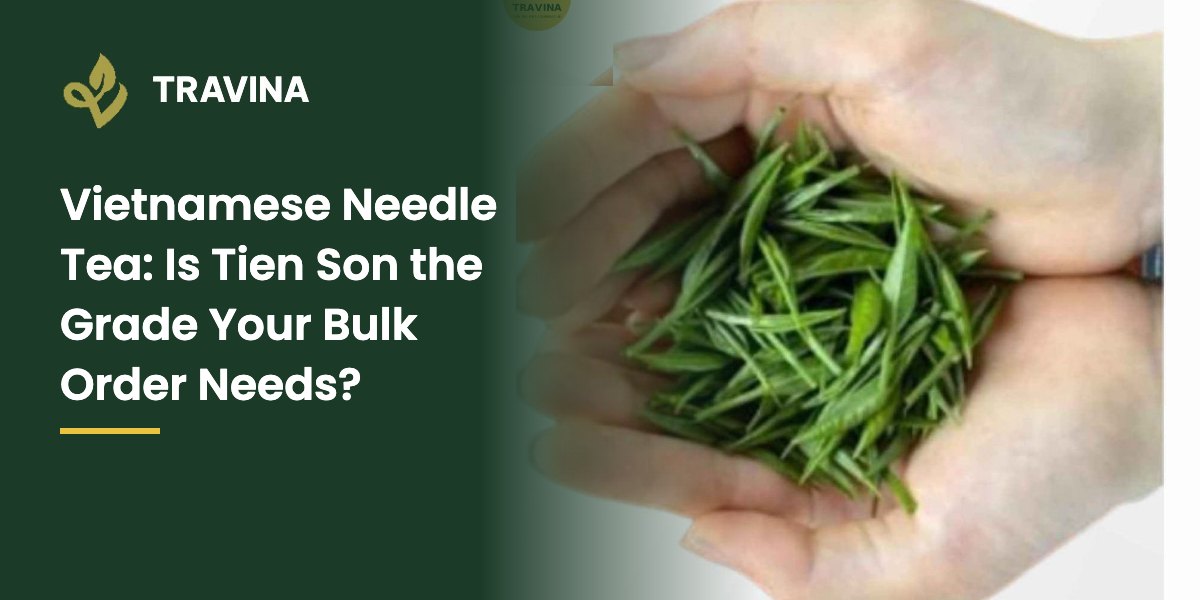
- For Trà Gạo Sen Bách Diệp Tây Hồ: needle-grade tea (trà đinh), a single unopened bud picked early in the morning. It is the same bud grade we sell plain as Trà Đinh Tiến Vua (Tien Vua Needle Tea) and Trà Đinh Tiên Sơn (Tien Son Needle Tea), formerly sold as Trà Đinh Ngọc. Making one kilogram of needle tea takes more than 10 kg of fresh buds.
- For Trà Sen Tây Hồ: bud-grade tea of one bud and the youngest shoot, the grade we sell plain as Trà Nõn Cánh Hạc (Canh Hac Bud Tea).
The gardens behind both grades are managed under our Six-No clean tea standard: no chemicals, no pesticides, no chemical fertiliser, no colouring, no bleaching and no preservatives. Six-No is our production commitment and applies to the tea; the lotus flowers come from West Lake growers. Dry tea readily absorbs smells, which is exactly why it can take on lotus scent. The same property means the base must be fully dried and kept away from any other odour before it meets the flowers.
Two ways to scent tea with lotus
Both methods start before sunrise. Lotus is cut early in the morning, when the bud is just beginning to open and the scent is held inside. After that the two methods split.
Whole-flower scenting: Trà Sen Tây Hồ
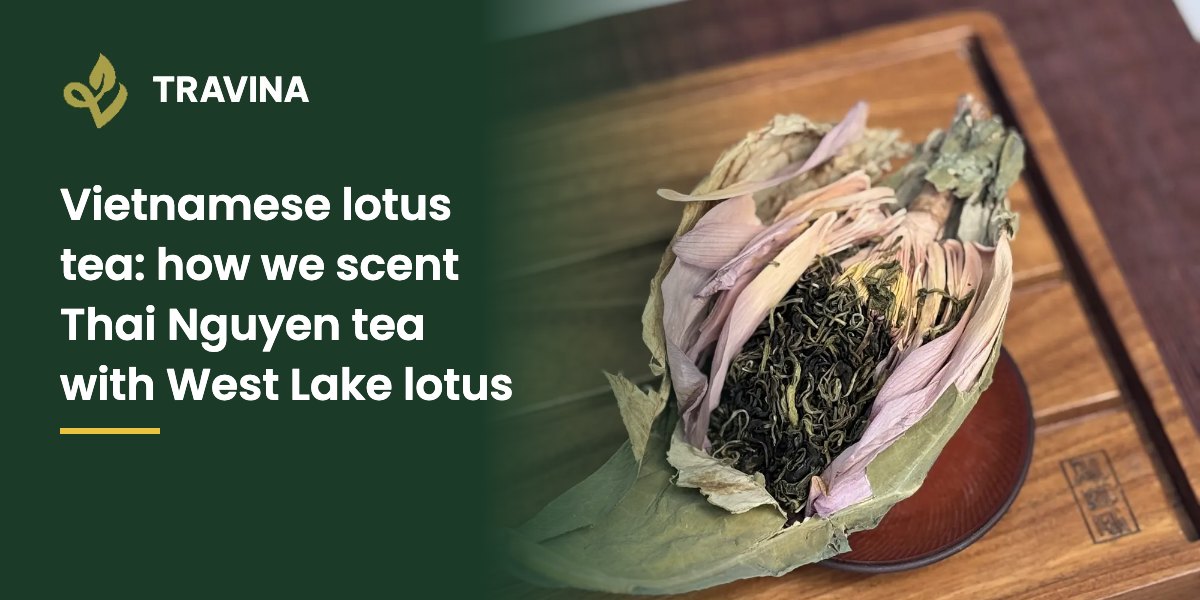
A portion of tea, about 15 g, is placed into the heart of a single fresh flower. The petals are closed around it and tied, and the flower is left so the tea takes up the scent. We then freeze-dry the flower so it keeps its shape, and vacuum-pack it. One flower brews roughly two to three pots. Whole-flower tea is quicker to make, looks striking when the box is opened, and suits gifting. Its lotus note is lighter than the lotus-rice method, and Vietnamese press describes it the same way.
Lotus-rice scenting: Trà Gạo Sen Bách Diệp Tây Hồ
This is the traditional West Lake method and the slow one. Each flower is opened by hand and the small white anther tips at the top of the stamens, called gạo sen or “lotus rice”, are picked out. Tea and lotus rice are laid in alternating layers and left to rest, then the tea is dried. The cycle is repeated, and published accounts of the Quảng An craft describe five to seven rounds, about two days of scenting per round, and one to two weeks to finish one kilogram. The flower count is the striking part: 1,000 to 1,400 lotus flowers for one kilogram of tea, or at least 1,000 selected flowers for the kilogram of lotus rice that one kilogram of tea needs. After the last round, the spent lotus rice is sieved out. What goes into the pack is tea only.
| Trà Sen Tây Hồ (whole flower) | Trà Gạo Sen Bách Diệp Tây Hồ (lotus rice) | |
|---|---|---|
| Base tea | Bud grade, one bud and the youngest shoot | Needle grade, single bud |
| How the scent goes in | Tea sealed inside one fresh flower | Repeated layering with lotus rice, then drying |
| Flowers used | One flower per portion of about 15 g | Published range: 1,000–1,400 flowers per kg of tea |
| Time | Short | One to two weeks per kg |
| Scent | Lighter, fresh | Deeper, longer-lasting through several steeps |
| What the buyer receives | A dried flower with tea inside | Loose tea; lotus rice sieved out |
| Typical use | Gift boxes, tasting events | Premium loose tea, tins, single-brew sachets |
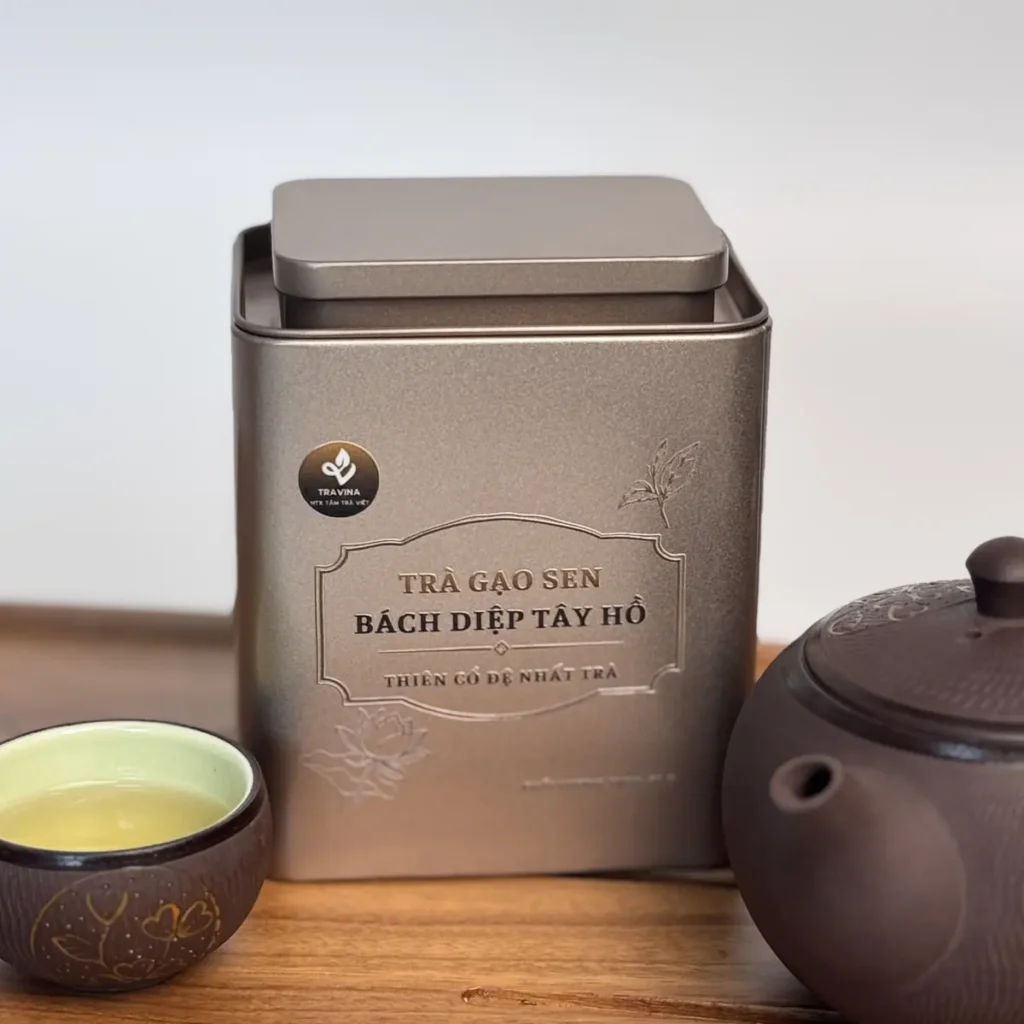
Trà Gạo Sen Bách Diệp Tây Hồ: our main lotus line for importers
If you are building a lotus tea range for a specialty shop or a gift catalogue, this is the product we would point you to first. It is the more traditional of the two styles, it keeps better as loose tea, and it carries the lotus through more infusions. The label reads, in substance: Thai Nguyen green tea (needle grade), scented with lotus rice from Bách Diệp lotus of West Lake, Hanoi. The full product sheet is on the West Lake Lotus Rice Tea (Trà Gạo Sen Bách Diệp Tây Hồ) page.
What a taster notices: the dry leaf already smells of lotus before water touches it. The needles are small and even. In the cup, the lotus comes first and the sweet, low-astringency finish of the needle tea follows. For brewing, we suggest 8–10 g for a standard pot, water around 80°C, and a short first steep of about 20 seconds, adding roughly 10 seconds for each further steep.
Packing options we already run:
- a 100 g tin for retail and gifting;
- a box of individually sealed single-brew sachets, one sachet per pot, with the sachet count confirmed per order;
- loose tea in sealed bulk packs for buyers who repack under their own label, discussed case by case.
Who buys it: tea shops that already sell scented teas and want a Vietnamese one, gift retailers, hotels and restaurants serving a signature tea, and companies buying Lunar New Year gifts for partners in Chinese-speaking markets. The volume is small by nature, so it fits buyers who order by the carton rather than by the pallet.
The lotus season: May to July, and what it means for your order
West Lake lotus does not flower all year. The Bách Diệp buds start opening around late May and early June, and the busiest scenting weeks fall around June. Scenting continues into July, but late-season flowers are smaller; Vietnamese press notes that July needs 100–200 more flowers for each kilogram of tea. Once the ponds stop flowering, no new lotus tea can be made until the following year.
That has five practical consequences for an importer:
- Volume is capped by flowers, not by tea. We have enough base tea; what limits us is how many fresh flowers we can secure in the season.
- Book before the season opens. If you tell us your volume and pack format by early spring, we set aside base tea from the spring harvest and plan our flower purchases around your order.
- Off-season orders ship from stock. After July, we sell from what was made during the season. When it runs out, the next lot comes the following summer.
- Lead time depends on the method. Lotus-rice scenting alone takes one to two weeks per batch before packing. We quote lead time per order; our general note on MOQ, price and lead time for Vietnamese tea explains how we work it out.
- Quotes are per season. Flower supply and cost change from year to year, so we quote lotus tea EXW in USD for the current season rather than publishing a list price.
| Months | What happens | What the buyer does |
|---|---|---|
| March – April | Spring tea harvest; base tea made and set aside | Request samples from the previous season, confirm volume and pack |
| May – July | Lotus season; scenting rounds | Approve pre-shipment sample of the new lot |
| August – November | Packing, documents, shipping | Receive goods ahead of year-end and Lunar New Year selling |
| December – February | Sales from season stock | Reorder only while stock lasts |
Keeping the aroma: storage, shelf life and shipping
Lotus scent is the most fragile part of the product. Oxygen, heat, light, moisture and stronger smells all wear it down, and once lost it cannot be added back. Shelf life is printed on each pack, following our registered product declaration, and we state it again on the pro-forma so your label and import file match.
Inside the pack, our job is to slow those losses. Whole flowers are freeze-dried and vacuum-packed. The lotus-rice tea goes into a tin or into individually sealed sachets, so each pot is opened fresh. For buyers, the rules are simple:
- store cool and dry, out of direct sunlight;
- keep lotus tea away from coffee, spices, soap and cleaning products, in the warehouse and in the container;
- reseal tightly after opening, or keep the opened pack in the refrigerator;
- sell first-in, first-out, and avoid open display jars for lotus tea;
- in hot months, ask your forwarder about routing that avoids long waits in hot yards.
A practical point for gift buyers: lotus tea made in June and sold at Lunar New Year has spent several months in transit and storage. Good sealing matters more for this product than for plain green tea.
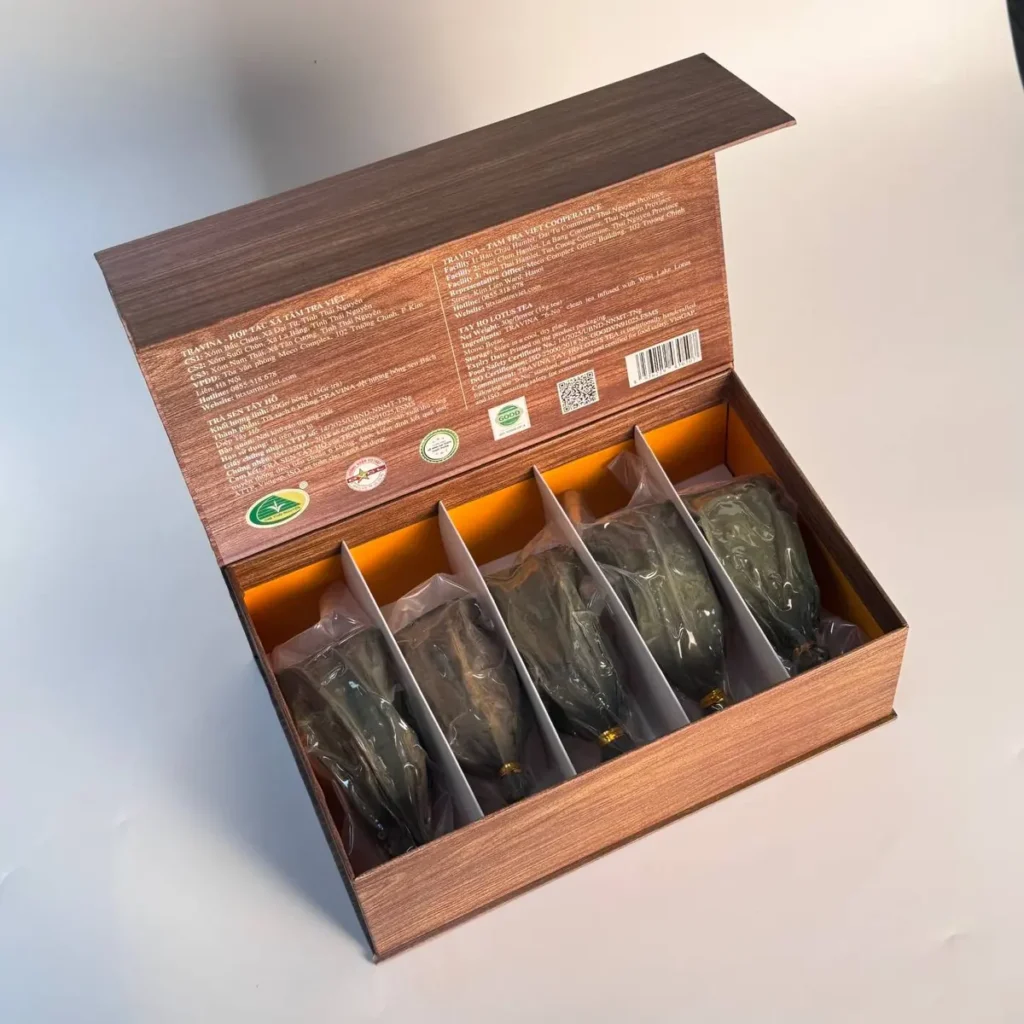
Gift packaging, labels and private label
Lotus tea sells largely as a gift, so packaging is part of the product. Our current formats:
- Trà Sen Tây Hồ (West Lake Lotus Tea): a single freeze-dried flower filled with tea, in a gift box with a carry bag.
- Tâm Trà Thanh Liên (lotus gift set): five lotus flowers in a wood-look paper gift box with sleeve and carry bag, the lid carrying a Đông Sơn drum motif. Net weights are confirmed on order.
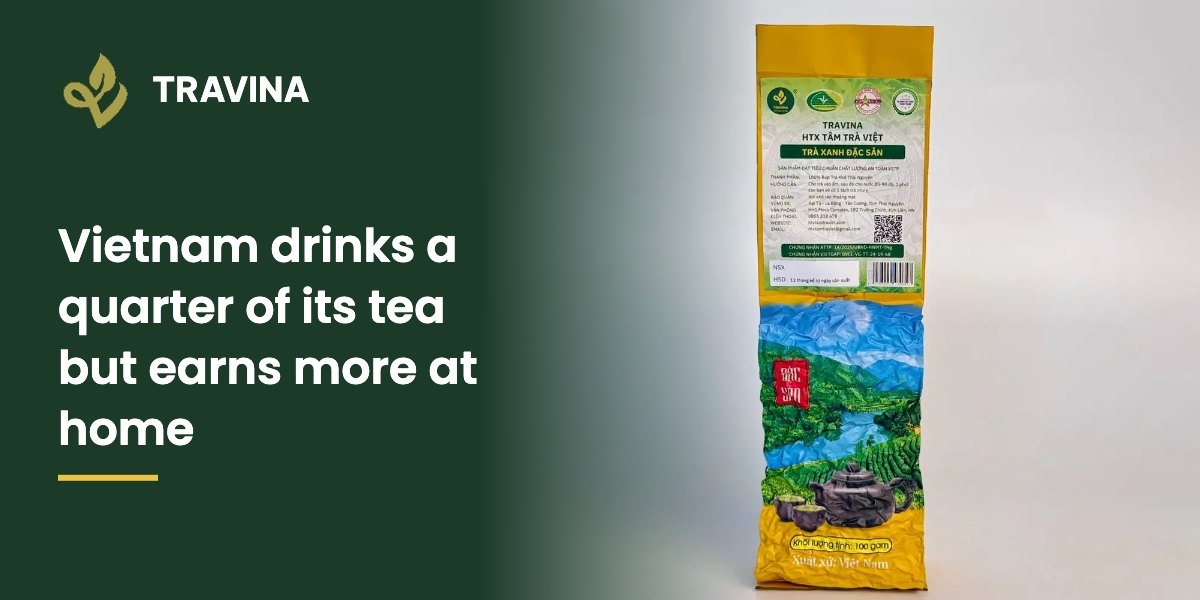
- Trà Gạo Sen Bách Diệp Tây Hồ: 100 g tin or a box of single-brew sachets.
Bulk, private label and export packing can be discussed for each order; our bulk tea export and private label page explains the two ways we supply. If you sell into mainland China, pre-packaged tea needs a Chinese-language label. We cover what the label must show in Chinese labels for imported Vietnamese tea and the registration rules in importing Vietnamese tea to China under GACC Decree 280. For Lunar New Year gifting, plan backwards: the tea is scented in summer, so artwork and label text should be agreed before packing starts.
How to order Vietnamese lotus tea from us
- Taste first. Ask for samples of both styles. We ship from the latest season’s stock; our guide on how to sample Vietnamese tea explains how to brew and compare them fairly.
- Tell us the essentials. Product, pack format, approximate volume, destination port or country, and whether you need your own label.
- Receive an EXW quote in USD. MOQ is not fixed for lotus tea. It depends on the season’s output and on the pack format you choose.
- Check the documents. We hold VietGAP certification (DVCL-VG-TT-24-19-68), ISO 22000:2018 for the La Bằng facility (GOODVN91025.FSMS) and a food safety licence (14/2025/UBND-NNMT-TNg). Scans are on our certificates and licences page. The phytosanitary certificate and certificate of origin are issued for each shipment.
- Confirm before the season. For new-season lotus tea, the earlier the confirmation, the more we can reserve.
FAQ
Is Vietnamese lotus tea flavoured?
Ours is not. The scent comes from fresh West Lake lotus, either from the whole flower or from lotus rice. No flavouring is added, and the ingredient line on our label says so.
What is the difference between Trà Sen Tây Hồ and Trà Gạo Sen Bách Diệp Tây Hồ?
Trà Sen Tây Hồ is bud-grade tea sealed inside one whole flower, then freeze-dried; it is light and made for gifting. Trà Gạo Sen Bách Diệp Tây Hồ is needle-grade tea layered with lotus anthers over several rounds, then sieved; it has a deeper scent and is sold as loose tea in tins or sachets.
Can you make lotus tea outside the May–July season?
No. New lotus tea can only be made while the West Lake lotus is flowering. Outside the season we ship from stock made that summer, so for large or custom orders please book before the season starts.
What is the shelf life?
It is printed on each pack according to our product declaration, and we confirm it on the pro-forma invoice. In practice the aroma lasts longest when the pack stays sealed, cool and away from other smells.
Can you pack lotus tea under our own brand?
Private label and export packing are discussed per order. Because lotus tea volume is limited each season, please send your artwork plan and volume early so packaging and scenting can be scheduled together.
Do you grow the lotus yourselves?
No. We grow and make the tea in Đại Từ – La Bằng, Thai Nguyen. The Bách Diệp lotus comes from West Lake growers in Hanoi each season.
How are the tea gardens farmed?
Our gardens are farmed toward organic practice under our Six-No commitment. The certificates we hold are VietGAP for the raw-material area and ISO 22000:2018 for the La Bằng facility.
Sources
- Nhân Dân, “Trà ướp sen Tây Hồ” (special report), 2 July 2024: special.nhandan.vn
- Báo Lào Cai, “Nghề ướp trà sen Quảng An, Tây Hồ trở thành Di sản văn hóa phi vật thể quốc gia”, 14 August 2024: baolaocai.vn
- VTV / Nhân Dân English, “Craft of West Lake lotus tea infusion recognised as national intangible cultural heritage”, 15 August 2024: english.vtv.vn
- Vietnam National Authority of Tourism, “Different colours of Vietnamese tea”, 20 November 2012: vietnamtourism.vn
- FAO, Intergovernmental Group on Tea, “Current global market situation and medium-term outlook”, CCP:TE/24/2, January 2024: fao.org
Planning a lotus tea range for next season? Send us your volume, pack format and destination, and we will reply with samples, an EXW quote in USD and a booking window for the coming lotus season. Contact TRAVINA.