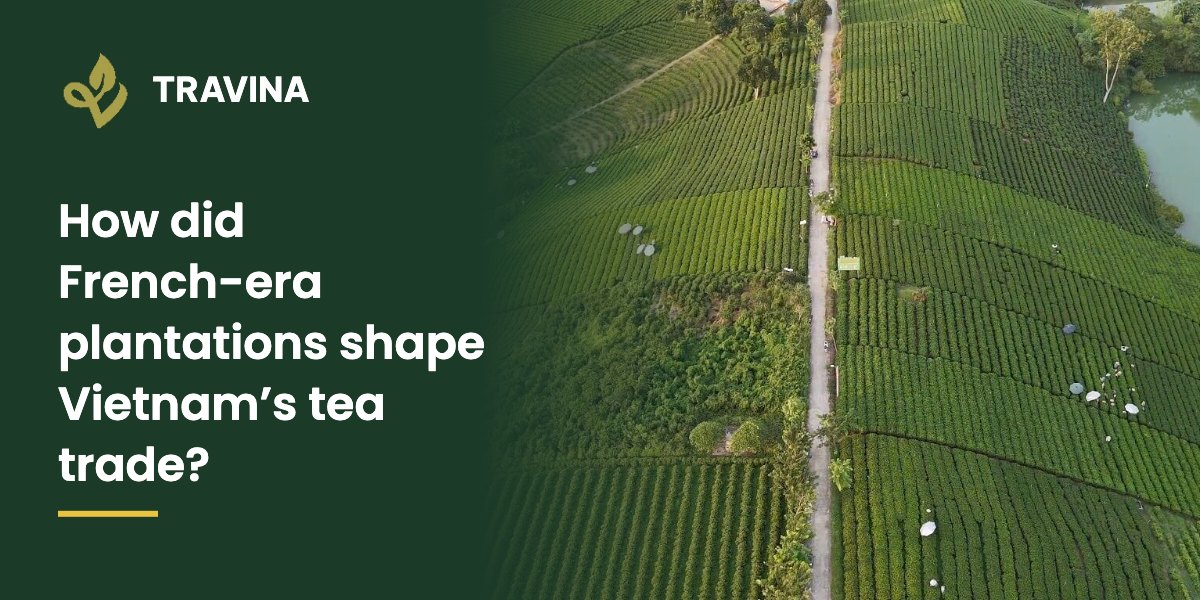
How did French-era plantations shape Vietnam’s tea trade? They turned tea from a village crop into an export commodity. The first commercial plantations appeared in the 1880s and 1890s, research stations followed in 1917–1918, and factories, export contracts with French tea houses and a large black tea industry in the Central Highlands came in the 1920s and 1930s. Some of these foundations still define Vietnamese tea today: black tea for blending, factories in Phu Tho and Lam Dong, and a split between household green tea and industrial export tea.
Timeline of the colonial tea trade
| Year | Event | Source |
|---|---|---|
| 1884 | A 250-hectare tea plantation at Phu Thuong, Hoa Vang (Quang Nam) | VnBusiness, 2023 |
| 1890 | A 60-hectare plantation at Tinh Cuong, Cam Khe (Phu Tho) | VnBusiness, 2023 |
| 1917–1918 | Four agricultural research stations opened; Phu Ho and Pleiku specialise in tea | O. Tessier, 2013 |
| 1925 | First tea factory in Indochina at Phu Ho; northern Vietnam imports 340,000 kg of tea from China and exports 150,000 kg | VnBusiness 2023; P. Braemer 1927 |
| 1927 | Phu Ho’s output bought by Dammann of Paris; tea planted at B’Lao (Bao Loc); green tea for North Africa still only a plan | P. Braemer 1927; Báo Lâm Đồng 2025 |
| 1930 | Construction of the tea factory at Bao Loc begins | Báo Lâm Đồng 2025; Pháp Luật TP.HCM |
| 1935–1938 | Indochina’s tea area falls from about 13,000 ha to 6,100 ha | Brocheux, cited by Tessier |
| 1940 | First Vietnamese tea cooperative founded at Thanh Ba with 50 growers, with help from French engineer E. Lhomme | VnBusiness, 2023 |
From village tea to export plantations
Before French rule, tea in Vietnam was grown and drunk locally; Vietnamese scholars recorded tea hills and the habit of drinking fresh green tea. The colonial administration saw tea as a potential export, and the first plantations were laid out in Quang Nam in 1884 and in Phu Tho in 1890. Progress was slow. A 1927 report by P. Braemer, head of agricultural services in Tonkin, admitted that northern Vietnam still imported more tea from China than it exported: 340,000 kg against 150,000 kg in 1925.
Research, factories and French buyers
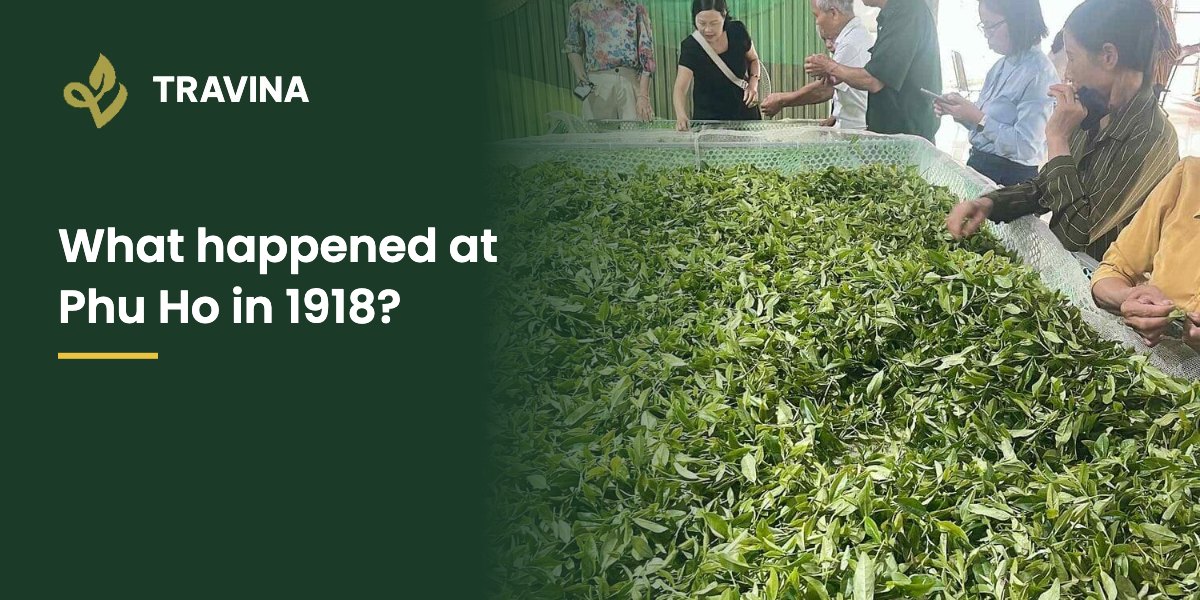
From 1917–1918, the botanist Auguste Chevalier set up research stations, with Phu Ho and Pleiku specialising in tea. Phu Ho received Indochina’s first tea factory in 1925. Its small output, about 2,000 kg a year, was bought by Dammann, a tea house in Paris, for sale in France. Braemer also described a plan to make green tea for North Africa, a large market for green tea at the time, but noted that it had not yet started. Historian Olivier Tessier mentions an Indochina office set up in Algeria to promote colonial produce.
Bao Loc and the Central Highlands
In the south, the French planted Assam-type tea at B’Lao, today’s Bao Loc in Lam Dong, from 1927, and began building a tea factory there in 1930. Báo Lâm Đồng calls this the starting point of Lam Dong tea; the factory, now known locally as the “1927 tea factory”, later ran orthodox and CTC black tea lines and, in 1986, exported black tea to the Soviet Union and Eastern Europe. Bao Loc became known as Vietnam’s “tea capital”, and Lam Dong remains a major black tea and oolong province.
A boom that did not last
Colonial publications described a “tea revolution” in Phu Tho, but Tessier argues that these reports misrepresented what was happening: citing the historian Pierre Brocheux, he notes that the tea area of Indochina fell from about 13,000 hectares in 1935 to 6,100 hectares in 1938. Much of the tea grown by Vietnamese households continued to be sold locally, outside the plantation system.
What remains today
- Black tea for export. Black tea made in industrial factories is still around 40% of Vietnam’s tea exports, much of it for blending.
- Research. The Phu Ho station became the institute that breeds Vietnam’s improved tea cultivars.
- Two parallel systems. Industrial factories for export grades sit alongside household green tea workshops, which still make up to half of Vietnam’s green tea.
- Selling under someone else’s name. In the 1920s Vietnamese tea reached Paris through a French tea house. Today much of it still leaves as unbranded raw material, which is why origin-labelled tea is the next step.
Read more in what happened at Phu Ho in 1918, how long Vietnam has been drinking tea and what kinds of tea Vietnam exports.
Frequently asked questions
When did the French start growing tea in Vietnam?
The first plantations recorded by VnBusiness were in Quang Nam in 1884 and Phu Tho in 1890.
Where was Indochina’s first tea factory?
At Phu Ho, Phu Tho province, in 1925.
When did tea come to Bao Loc?
In 1927, when the French planted Assam-type tea at B’Lao; work on the factory began in 1930.
Who bought Vietnamese tea in the 1920s?
The 1927 report says the output of Phu Ho was bought entirely by Dammann in Paris.
Sources
- VnBusiness, early plantations, the first factory and cooperative, 17 May 2023: vnbusiness.vn
- P. Braemer, “Tonkin: relance du thé”, L’Éveil économique de l’Indochine, 8 May 1927: entreprises-coloniales.fr
- O. Tessier, “Colonial Misrepresentation of the ‘Tea Revolution’ in the Province of Phu Tho (Tonkin), 1920–1945”, Annales HSS, 2013: cambridge.org
- Báo Lâm Đồng, B’Lao tea since 1927, 29 January 2025: baolamdong.vn
- Pháp Luật TP.HCM, the Bao Loc tea factory: plo.vn
Buying Vietnamese tea under its own name? Contact TRAVINA for origin-labelled Thai Nguyen teas.