What kinds of tea does Vietnam export? Mainly two: green tea and black tea. In 2024 green tea made up about 55% of Vietnam’s tea exports and black tea about 42.5%, with scented teas and oolong making up the small remainder. By FAO’s count, Vietnam is the world’s second-largest exporter of green tea after China. The mix matters because each type sells at a very different price: in 2023 oolong fetched more than twice as much per tonne as black tea. Here are the numbers and what they mean for buyers.
Vietnam’s tea exports by type
| Type | 2023 volume | 2023 value | Average price (USD/t) | 2024 share |
|---|---|---|---|---|
| Green tea | 57,500 t | 113.5 million USD | about 1,970 (our calculation) | about 55% |
| Black tea | 46,000 t | 62.4 million USD | about 1,360 (our calculation) | about 42.5% |
| Scented tea (lotus, jasmine and others) | 3,800 t | not reported | not reported | remainder |
| Oolong | 1,300 t | not reported | about 2,900 |
Sources: VnEconomy (January 2024) for 2023 volumes, values and the oolong price; VnEconomy republished by Báo Lào Cai (March 2025) for the 2024 shares. The 2023 figures by type are from a different data set than the total export figure, so they do not add up exactly to the national total of about 120,000 tonnes.
Green tea: Vietnam’s strongest category
According to an FAO paper for the Intergovernmental Group on Tea (January 2024), Vietnam exported on average 65,301 tonnes of green tea a year in 2020–2022, second only to China’s 310,730 tonnes and ahead of Japan and Indonesia. Vietnam was also the world’s second-largest green tea producer, at 99,333 tonnes. Most of this is bulk green tea for blending and re-packing, but it also includes graded teas from Thai Nguyen and the northern highlands.
Green tea also earns more per tonne than black tea. On the 2023 figures, green tea averaged about 1,970 USD per tonne against about 1,360 for black tea. If you are buying Vietnamese tea for its own character rather than as a filler, green tea is usually where to start; see an honest guide to Thai Nguyen green tea.

Black tea: volume for blending
Black tea is the other half of the export trade. FAO ranked Vietnam sixth in the world for black tea exports in 2022, at about 60,000 tonnes, and eighth for black tea production. Much of it is orthodox or CTC black tea made in industrial factories in Phu Tho, Lam Dong and other provinces and sold in bulk for blending. Its low unit price is one reason Vietnam’s average export price sits at about 55–65% of the world average.
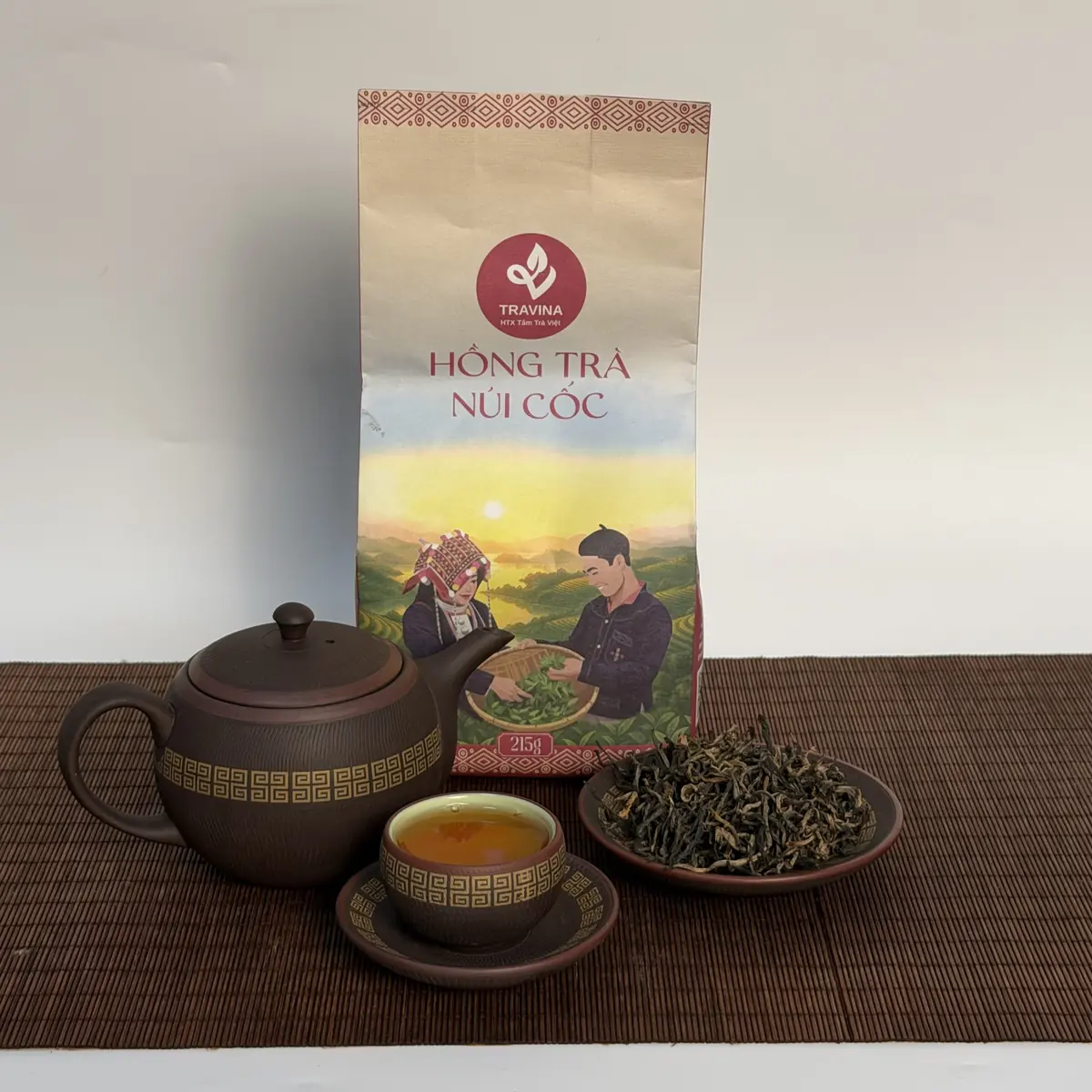
Smaller, specialty black teas made from northern leaf are a newer category. Our Nui Coc black tea is one example.
Oolong and scented teas: small but higher value
Oolong is a small export, around 1,300 tonnes in 2023, but it fetched about 2,900 USD per tonne, the highest of the main categories. Most Vietnamese oolong comes from Lam Dong, made from cultivars introduced from Taiwan, and Taiwan is one of Vietnam’s largest tea markets; we explain why in why Taiwan buys Vietnamese tea. Scented teas, mainly lotus and jasmine, were about 3,800 tonnes. These are categories where Vietnamese tradition is strong and buyers pay for craft.
A note on a figure to avoid
Some Vietnamese articles state that green tea makes up “about 94%” of Vietnam’s tea exports. That figure conflicts with the type breakdown published in the same articles and with FAO data, so we do not use it. On the evidence available, green and black tea are close to an even split, with green tea slightly ahead.
What this means for buyers
- For blends and private label: bulk green or black tea is widely available; ask for consistency between lots and residue test reports.
- For a recognisable Vietnamese product: graded green tea, lotus tea or jasmine tea tell a clearer origin story than bulk black tea.
- For higher margins: oolong, scented teas and graded Thai Nguyen green teas sell at higher prices per kilo; ask for small trial orders first.
For the overall market picture, see Vietnam tea export statistics 2025; for larger orders, our bulk tea export page.
Frequently asked questions
Does Vietnam export more green tea or black tea?
Slightly more green tea: about 55% green and 42.5% black in 2024.
Where does Vietnam rank in green tea exports?
Second in the world after China, with an average of 65,301 tonnes a year in 2020–2022, according to FAO.
Which Vietnamese tea type earns the most per tonne?
Oolong, at about 2,900 USD per tonne in 2023, followed by green tea at about 1,970 and black tea at about 1,360 (our calculation from published figures).
Does Vietnam export scented tea?
Yes, about 3,800 tonnes in 2023, mainly jasmine and lotus tea.
What does TRAVINA export?
Mainly Thai Nguyen green teas in several grades, plus lotus, jasmine, oolong and black tea. Contact us for an EXW quote.
Sources
- VnEconomy, Vietnamese tea exports by type, 11 January 2024: vneconomy.vn
- VnEconomy, republished by Báo Lào Cai, export shares 2024 and forecasts, 2 March 2025: baolaocai.vn
- FAO, Intergovernmental Group on Tea, CCP:TE/24/2, January 2024: fao.org
- Nhân Dân, Vietnamese export prices compared with the world, 14 December 2024: nhandan.vn
- Tuổi Trẻ, oolong in Lam Dong, 3 November 2006: tuoitre.vn
Choosing between green, black and scented tea? Contact TRAVINA and we will send samples of each.