
Before a first order from a Vietnamese tea supplier, twelve questions cover most of the risk: where the leaf grows, who holds which certificate and for which site, what the latest test report shows, how lots are kept apart, how much the supplier can really make in a season, and how payment, lead time and complaints work. A supplier that answers these clearly, with documents rather than adjectives, is usually one you can work with. Below, each question comes with the answer TRAVINA – Tam Tra Viet Cooperative gives, so you can see what a concrete answer looks like and compare it with other suppliers.
| # | Question | What a good answer includes |
|---|---|---|
| 1 | Where exactly is the tea grown? | Named area, who farms it, planting-area code |
| 2 | Who picks it, and how? | Hand or machine; picking standard per grade |
| 3 | Which certificates, for which site? | Certificate holder, scope and validity |
| 4 | What does the latest test report show? | Accredited lab, what was tested, results |
| 5 | Can you test the lot you ship? | Yes, with an agreed test list |
| 6 | How are lots kept apart and traced? | Lot codes, dates, retained samples |
| 7 | How much can you supply, and when? | Annual and seasonal capacity |
| 8 | How is the tea packed? | Inner pack, carton, loading plan |
| 9 | Which Incoterm and port? | EXW/FOB etc., named port |
| 10 | What are the payment terms? | Deposit, balance, private label terms |
| 11 | What are the lead times? | Stock vs private label |
| 12 | What happens if a lot is not right? | Reference sample, lot sample, contact |
Origin and growing
1. Where exactly is the tea grown?
A supplier should name the area and say who farms it. Our answer: 90 member households of the cooperative farm 40.5 hectares in Dai Tu and La Bang, Thai Nguyen province, under VietGAP practice, with a registered planting-area code. See our guide to the Dai Tu and La Bang growing areas.
2. Who picks it, and how?
Picking decides the grade. Our answer: all our tea is picked by hand, with no machine harvesting on any line; the picking standard runs from one bud and two leaves for everyday green tea to bud only for needle teas. See Thai Nguyen green tea grades.
Certificates and testing
3. Which certificates, for which site?
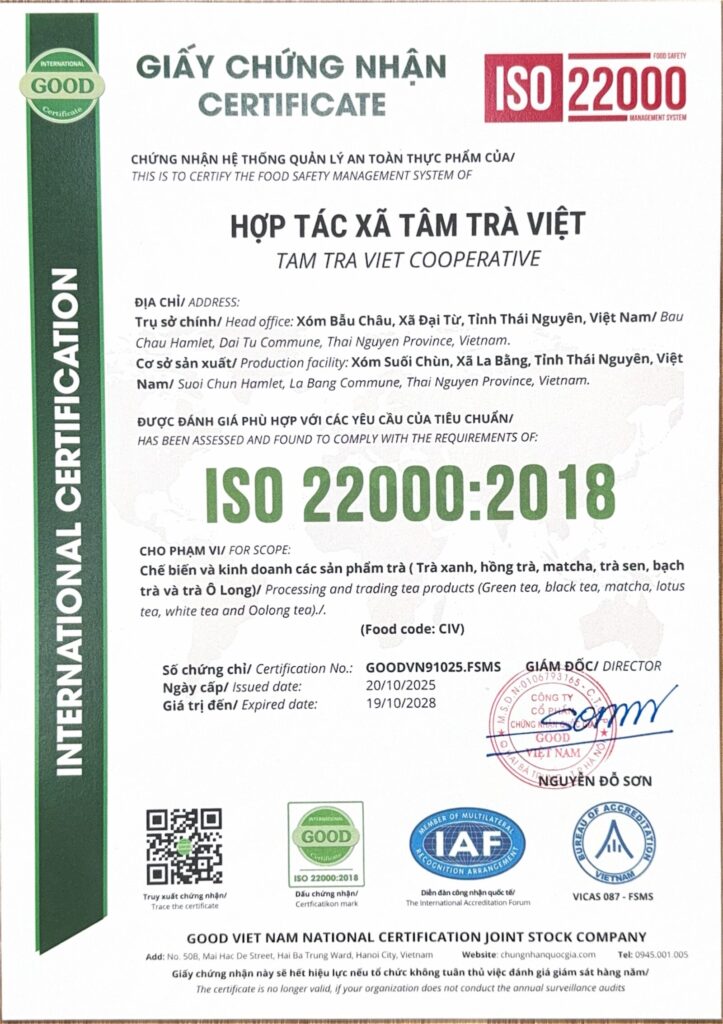
Check the holder, the scope and the dates on each certificate, not just its name. Our answer: ISO 22000:2018 food safety management covers our La Bang processing facility; VietGAP covers the raw-material area; the food safety eligibility certificate covers the processing site. The full list is on our certificates page.
4. What does the latest test report show?
Ask for the report itself, from an accredited laboratory. Our answer: we share recent pesticide residue test reports on request; our product pages show examples with the report numbers.
5. Can you test the lot you ship?
A report on an old batch is not a report on your lot. Our answer: yes; agree the test list and limits for your market before the order and we arrange testing on the lot to be shipped. See export documents for Vietnamese tea.
6. How are lots kept apart and traced?
Our answer: each pack carries a production date and lot code, we keep a retained sample from every lot, and a sealed reference sample is kept for each private label order.
Capacity, packing and shipping
7. How much can you supply, and when?
Ask for real numbers and the season behind them. Our answer: about 120 tonnes of dry tea in a normal year, picked from March to October with June the highest month. Bud grades are limited and should be reserved early. See our harvest calendar.
8. How is the tea packed?
Our answer: sealed inner packs (vacuum or foil), cartons with shipping marks matching the packing list, and a loading plan confirmed with the quote.
9. Which Incoterm and port?
Our answer: we quote in USD on EXW or FOB terms; FOB Hai Phong is the usual basis. See FOB, CIF or EXW for Vietnamese tea.
Commercial terms
10. What are the payment terms?
Our answer: stock tea is quoted per order; private label (OEM) work starts from 20,000,000 VND per order with a 20–30% deposit when the contract is signed. See private label tea in 7 steps.
11. What are the lead times?
Our answer: stock tea under 100 kg leaves our warehouse within 24 hours, and 100 kg or more within 2 days; orders of a tonne and above are scheduled by agreement. Private label takes longer because packaging is made first. See MOQ, price tiers and lead times.
12. What happens if a lot is not right?
Agree this before the first order, not after. Our answer: the sealed reference sample and the retained lot sample are compared side by side, so the question is settled on evidence; tell us what you found and send photos or a test report.
Seeing it for yourself
Documents answer most questions; a visit answers the rest. Our one-day factory visit for importers covers both sites, a cupping session and a documents review.
Send us your supplier questionnaire. Importers can request samples of Traditional Northern Green Tea, Special Green Tea or Broken Needle Tea Bags through our Contact page, or message our export team on Zalo/WhatsApp at +84 855 318 678. If you have your own supplier approval form, send it and we will fill it in with the supporting documents.
Frequently asked questions
What documents should I ask a Vietnamese tea supplier for?
Certificates with their scope and validity, a recent accredited test report, and for each shipment the commercial invoice, packing list, bill of lading, phytosanitary certificate and, if needed, a certificate of origin.
Is ISO 22000 enough on its own?
It shows a food safety management system at a named site. Check that the site on the certificate is the one making your tea, and still ask for a test report on your lot.
How do I check capacity?
Ask for annual output, the harvest months and how much of the grade you want is made each season, then compare with your order.
Should I visit before ordering?
It helps, especially for larger or private label orders. If you cannot travel, start with samples and a document review.


