A formal export lot of tea from Vietnam usually travels with five core documents: a commercial invoice, a packing list, a bill of lading or air waybill, a phytosanitary certificate and, when the buyer wants a lower import duty, a certificate of origin. Laboratory test reports are added according to the rules of the destination market. Company-level certificates, such as ISO 22000, do not travel with each shipment, but buyers often ask for a copy before the first order. This guide explains who issues each document, when it is needed and what TRAVINA – Tam Tra Viet Cooperative can provide.
| Document | Issued by | Needed for | Notes |
|---|---|---|---|
| Commercial invoice | Exporter | Every shipment | Shows goods, quantity, unit price, Incoterm and payment terms |
| Packing list | Exporter | Every shipment | Net and gross weight, number and type of cartons, marks |
| Bill of lading / air waybill | Shipping line or airline (via forwarder) | Every shipment | Proof of shipment; the original B/L is often needed to collect the goods |
| Phytosanitary certificate | Vietnam’s plant protection authority | Most markets for tea, a plant product | Issued after inspection of the lot, before loading |
| Certificate of origin (C/O) | Vietnam’s Ministry of Industry and Trade or an authorised body | When the buyer claims a preferential tariff | Form depends on the trade agreement, e.g. Form E for China |
| Laboratory test report | Accredited laboratory | As required by the market or the buyer | Pesticide residues, heavy metals, microbiology, moisture |
| Fumigation / ISPM 15 mark | Approved treatment provider | Only when wooden pallets or crates are used | Not needed with plastic pallets or loose-loaded cartons |
The three commercial documents
The commercial invoice and packing list are prepared by the exporter for every lot. Customs in both countries read them, and so does the bank if you pay by letter of credit, so the product names, weights and carton marks must match across all documents. For tea, we write the grade, the pack format (for example 500 g vacuum bags in export cartons) and the net weight of tea, not only the gross weight.
The bill of lading (sea) or air waybill (air) is issued by the carrier once the goods are loaded. Under FOB your forwarder arranges it; under CFR or CIF the seller does. For a full explanation of who books the ship under each term, see our guide to FOB, CIF or EXW for Vietnamese tea.
Phytosanitary certificate
Tea is a plant product, so most importing countries ask for a phytosanitary certificate. In Vietnam it is issued by the plant protection authority’s regional plant quarantine offices after an inspection of the lot. The exporter files the request a few days before loading, the inspector checks the goods and the packing, and the certificate names the product, quantity, origin and destination.
The certificate confirms the lot was inspected and meets the importing country’s plant health requirements. It is not a quality grade and not a residue test, so it does not replace a laboratory report if your market needs one.
Certificate of origin: which form for which market
A certificate of origin proves the tea was produced in Vietnam. On its own it is a simple statement of origin; the reason buyers ask for it is that under a trade agreement it can lower or remove the import duty. Vietnam issues C/Os through the Ministry of Industry and Trade’s online system, and the form depends on the agreement, for example:
- Form E for China, under the ASEAN–China Free Trade Area;
- Form AK for Korea, under the ASEAN–Korea agreement;
- EUR.1 or an origin statement for the European Union, under the EU–Vietnam agreement (EVFTA);
- Form D for other ASEAN countries.
Your customs broker knows which form gives the lowest duty for your tariff line. Tell us before shipment, because the form, the HS code and the description on the invoice must all line up.
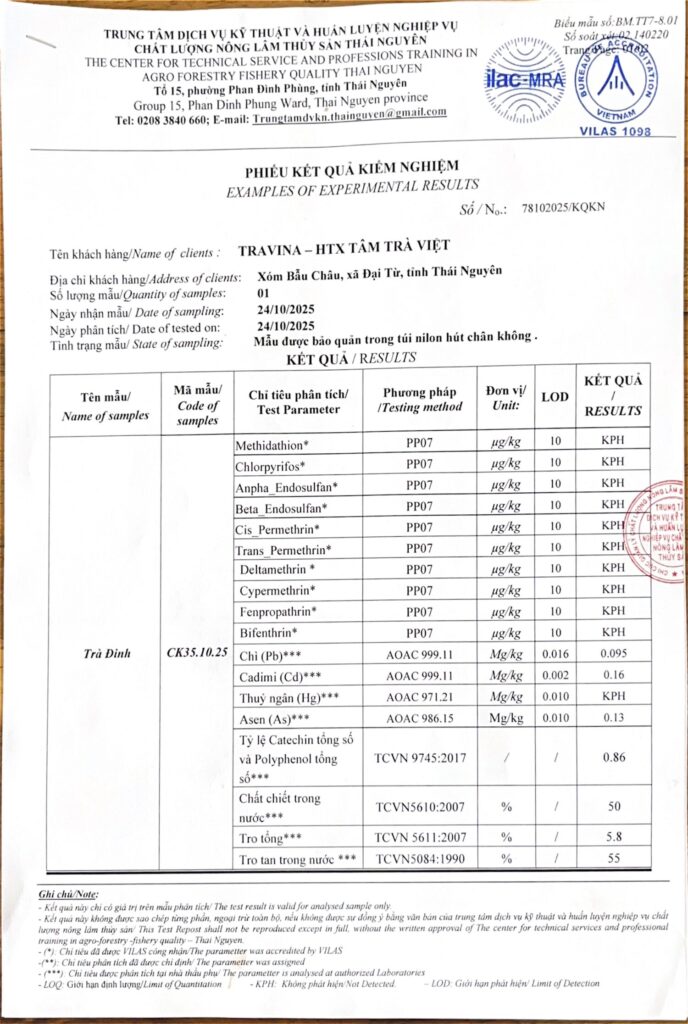
Laboratory test reports
Residue limits are set by the importing market, not by Vietnam, and they differ a lot between markets. A report from an accredited laboratory (ISO/IEC 17025) usually covers pesticide residues, and depending on the buyer may also cover heavy metals, microbiology and moisture. Three practical points:
- Agree the test list before the order. Send us your market’s limits or your own specification; a test panel that matches your rules saves a second round of testing.
- Test the lot you will ship. A report on an earlier batch shows how we work; a report on the shipping lot is what your customs or customer may ask for.
- Agree who pays. Testing has a cost and takes time. Write it into the quote and the contract.
Company certificates that support every shipment
Some documents belong to the producer rather than to the lot. Buyers usually ask for copies once, during supplier approval:
- ISO 22000:2018 food safety management at our La Bang processing facility;
- VietGAP good agricultural practice across a 40.5 ha raw-material area farmed by member households;
- Vietnam’s certificate of eligibility for food safety for the processing site;
- product self-declarations filed under Vietnamese food law for each tea line.
The full list, with what each document covers, is on our page Every certificate TRAVINA holds.
Extra steps for some markets
Some destinations add their own requirements on top of the core set. China, for example, applies GACC rules on overseas producer registration and Chinese-language labels; see importing Vietnamese tea into China under GACC Decree 280 and Chinese label requirements. Other markets may ask for a health certificate or a certificate of free sale. Ask your importer or customs broker what your market requires, and send us the list early.
Ask for the document set with your quote. Importers can request samples of Traditional Northern Green Tea, Special Green Tea or Broken Needle Tea Bags through our Contact page, or message our export team on Zalo/WhatsApp at +84 855 318 678. Tell us your destination and the documents your customs broker needs, and we will confirm what we can provide with the quote.
Frequently asked questions
Is a phytosanitary certificate required for tea?
Most importing countries ask for one, because tea is a plant product. Your importer or customs broker can confirm the rule for your market. In Vietnam it is issued after inspection of the lot before loading.
Which certificate of origin do I need for China?
Form E, under the ASEAN–China Free Trade Area, if you want the preferential tariff. Without it the tea can still be imported, but at the standard duty rate.
Can you send a test report for my market?
Yes, once we agree the test list. Send us the limits for your market or your own specification, and we will arrange testing at an accredited laboratory on the lot to be shipped.
Does ISO 22000 cover all your tea?
ISO 22000:2018 covers food safety management at our La Bang processing facility. Ask us which product lines are processed there for your order.
Do I need a fumigation certificate?
Only if the shipment uses wooden pallets or crates. Heat-treated wood with the ISPM 15 mark, or plastic pallets, avoid most problems.