
Japan accepts green tea from Vietnam, but its rules are strict and its buyers are exacting. Every lot is judged under the Positive List System: a pesticide with no Japanese limit for tea must not exceed a uniform limit of 0.01 ppm. Each shipment for sale needs an import notification at a quarantine station under the Food Sanitation Act, and the retail pack needs a Japanese label under the Food Labeling Act. Japanese buyers then ask about cultivar, picking standard, colour of the cup, lot consistency and test reports. Thai Nguyen green tea is pan-fired and tastes different from steamed Japanese tea, so whether a buyer uses it for blends, bottled tea, food or as a leaf tea in its own right, a clear specification and a clean residue report matter more than a story.
| Step | What applies | Who handles it |
|---|---|---|
| Residue limits | Positive List System since 29 May 2006; uniform limit 0.01 ppm where no limit is set for tea | Supplier tests, importer checks |
| Import notification | Food Sanitation Act; filed at a quarantine station for each shipment for sale | Japanese importer |
| Inspection | Documents reviewed; some lots sampled at the border | Quarantine station |
| Japanese label | Food Labeling Act: name, ingredients, net content, best-before, storage, importer, origin | Importer or brand owner |
| Import duty | Depends on the tariff line; a preferential rate under a trade agreement needs a valid certificate of origin | Importer and customs broker |
1. Residue standards: the Positive List System
Since 29 May 2006 Japan has applied a positive list to agricultural chemicals in food. Substances with a set limit for tea are judged against that limit; any substance without one is held to a uniform limit of 0.01 ppm. Standard-setting moved from the Ministry of Health, Labour and Welfare to the Consumer Affairs Agency in 2024, so the current limits are published by the CAA. As with the EU, a pesticide that is allowed in Vietnam may still have no Japanese limit for tea, and that is where the main risk sits. Agree the test list for Japan before the order and test the lot that will ship; our article on EU MRL rules for Vietnamese tea explains the same logic for Europe.
2. Import notification and inspection
Food imported into Japan for sale must be notified to a quarantine station under the Food Sanitation Act. The importer files the notification with the product details, the manufacturer and the processing method. The station reviews the papers and may take samples. A lot that fails is not released for sale. Practical point for the exporter: the product name, ingredients and processing description on our documents must match what the importer files, so send a clear specification with each lot. See export documents for Vietnamese tea.
3. The Japanese label
Retail packs sold in Japan carry a Japanese label under the Food Labeling Act, including the product name, ingredients, net content, best-before date, storage method, the importer’s name and address, and the country of origin. The importer is responsible for the label. For bulk tea the importer usually repacks and labels in Japan; for your own brand packed in Vietnam, we print the Japanese text you supply and keep a sealed reference sample of the approved pack.
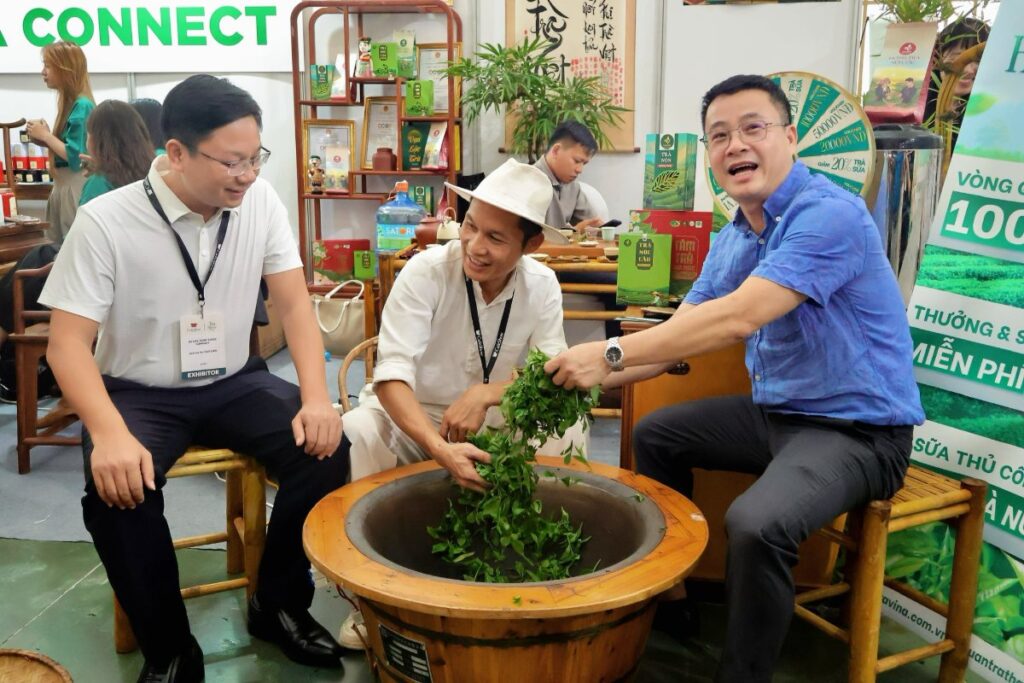
4. What Japanese buyers ask
- Cultivar and leaf: which tea variety and which picking standard. See Thai Nguyen green tea grades.
- Processing: Thai Nguyen green tea is pan-fired, not steamed like sencha, so the cup is different; buyers want to know this up front.
- Colour and consistency: dry leaf and cup colour within a narrow range from lot to lot, checked against a reference sample.
- Foreign matter and moisture: clean sorting and sealed packing.
- Documents: residue report on the lot, lot code, production date, and the facility’s food safety certificate. Our ISO 22000:2018 covers the La Bang facility only.
5. The matcha question
Demand for matcha has risen fast, and some buyers now look at origins outside Japan. Vietnamese matcha is still a small, young category. TRAVINA has milled trial batches but does not offer matcha for export today; our page on Vietnamese matcha from Thai Nguyen says exactly where we stand and which partners we are looking for. For Japan today, we supply pan-fired green tea and leaf for further processing.
Send us your Japanese specification. Importers can request samples of Traditional Northern Green Tea, Special Green Tea or Broken Needle Tea Bags through our Contact page, or message our export team on Zalo/WhatsApp at +84 855 318 678. Tell us the use (leaf, blend, bottled tea, food), the test list and the volume, and we will match a grade and test the lot before shipping. Price terms are on MOQ, price tiers and lead times.
Frequently asked questions
What residue limit applies if Japan has no limit for a pesticide on tea?
The uniform limit of 0.01 ppm under the Positive List System.
Who files the import notification?
The Japanese importer, at a quarantine station, for each shipment for sale.
Is Vietnamese green tea the same as Japanese sencha?
No. Thai Nguyen green tea is pan-fired, which gives a different cup. Buyers usually use it for blends, bottled tea or food, or as a leaf tea in its own right.
Does TRAVINA sell matcha to Japan?
Not today. We have milled trial batches and are looking for partners; see our matcha page.
Can import duty be reduced?
Vietnam and Japan are both parties to several trade agreements. A preferential rate needs the right certificate of origin; confirm the rate for your tariff line with your customs broker.


