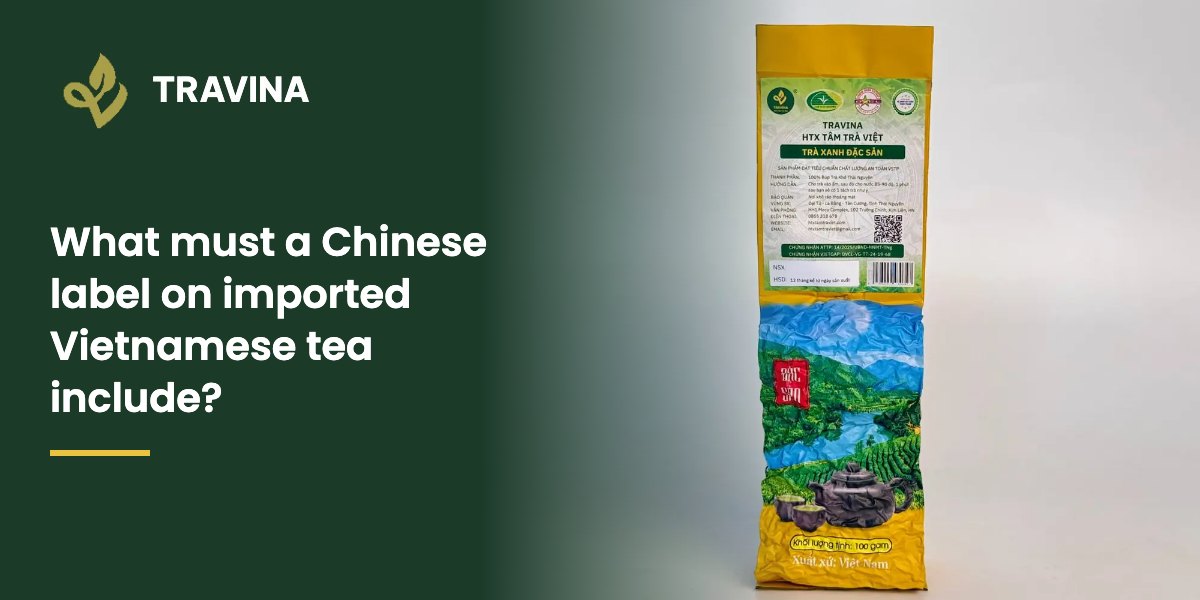
Vietnamese tea sold in China as prepackaged food must carry a Chinese label in standard simplified characters before it is released by customs. Under China’s Food Safety Law and GB 7718, that label must show the tea’s true name, the ingredient list, net content, production date and shelf life, storage conditions, the country of origin, and the name, address and contact details of the importer, agent or distributor registered in China. The overseas manufacturer’s GACC registration number goes on the package too. GB 7718-2011 applies today. GB 7718-2025 and SAMR Order No. 100 take effect on 16 March 2027 and add expiry-date marking and larger minimum type sizes.
| Label item | Rule in force in 2026 | From 16 March 2027 |
|---|---|---|
| Language | Standard Chinese characters; foreign text allowed, but no larger than the Chinese (GB 7718-2011, 3.8) | Standard simplified characters; foreign text no taller than the matching Chinese (SAMR Order 100, Art. 11) |
| Food name | A name that shows the true nature of the food, in a prominent position (4.1.2) | Same principle |
| Ingredient list | Required (4.1.3) | Required; eight allergen groups must be flagged where used |
| Net content | Number plus legal unit, on the same panel as the food name (4.1.5) | Covered by SAMR Order 100 |
| Dates | Production date and shelf life; state the order if not year-month-day (4.1.7) | Expiry date in year-month-day order; production date may be left off if shelf life is 6 months or more; dates in a separate area of the main panel |
| Storage conditions | Required (4.1.8) | Required |
| Origin and importer | Country of origin plus Chinese importer, agent or distributor name, address and contact (4.1.6.3; Food Safety Law Art. 97) | Food Safety Law Art. 97 still applies |
| Registration number | GACC registration number on the food packaging (Decree 280, Art. 14, in force since 1 June 2026) | Same |
| Minimum type height | 1.8 mm when the largest surface exceeds 35 cm² (3.9) | 1.8 mm; 2.0 mm above 150 cm²; 2.5 mm above 400 cm²; dates 3.0 mm (2.0 mm under 35 cm²) |
| Not needed on imported packs | Product standard code (4.1.10) | Product standard code and food production licence number (Order 100, Arts. 21–22) |
Which rules apply to a tea label in 2026 and 2027
Four layers of rules stack up. The Food Safety Law, last amended on 29 April 2021, says in Article 97 that imported prepackaged food must have a Chinese label stating the origin and the name, address and contact details of the domestic agent. Prepackaged food without a compliant Chinese label “shall not be imported”.
The labelling standard is GB 7718-2011, in force since 20 April 2012. Its revision, GB 7718-2025, was released by the National Health Commission and the State Administration for Market Regulation (SAMR) on 27 March 2025 and takes effect on 16 March 2027. SAMR Order No. 100, the Measures for the Supervision and Administration of Food Labelling, was issued on 14 March 2025 with the same start date and now holds rules on type size and net content.
On the customs side, GACC Decree No. 249 on import and export food safety has applied since 1 January 2022. Article 30 requires labels of imported food to meet Chinese law and national standards. GACC still cited Decree 249 in a March 2026 draft, and we found no replacement. GACC Decree No. 280 replaced Decree 248 on 1 June 2026; Article 14 requires the manufacturer’s registration number on the food packaging. Our guide to GACC Decree 280 and Vietnamese tea explains registration. This article covers the label itself.
The label checklist for a pack of Vietnamese tea
The table below turns the rules into a check you can run before artwork goes to print. Note the last column: some lines must come from the Chinese buyer.
| Check | What to write | Who supplies it |
|---|---|---|
| Food name | A name showing what the product is, for example 绿茶 (green tea). A brand or fancy name can appear as well, but not in place of the true name. | Exporter, agreed with importer |
| Ingredient list | 配料: 绿茶. Add every other ingredient in descending order if the tea is scented or blended. | Exporter |
| Net content | 净含量 with figure and legal unit, such as 净含量: 100克, on the same panel as the name. | Exporter |
| Production date and shelf life | 生产日期 and 保质期. State the order if you do not use year-month-day. | Exporter (printed at packing) |
| Storage conditions | 贮存条件, for example a cool, dry place away from light and odours. | Exporter |
| Country of origin | 原产国: 越南 | Exporter |
| Importer, agent or distributor | Name, address and contact details of the company registered in China. | Chinese importer |
| Registration number | The overseas manufacturer’s GACC registration number, or the number approved by the Vietnamese authority. | Manufacturer |
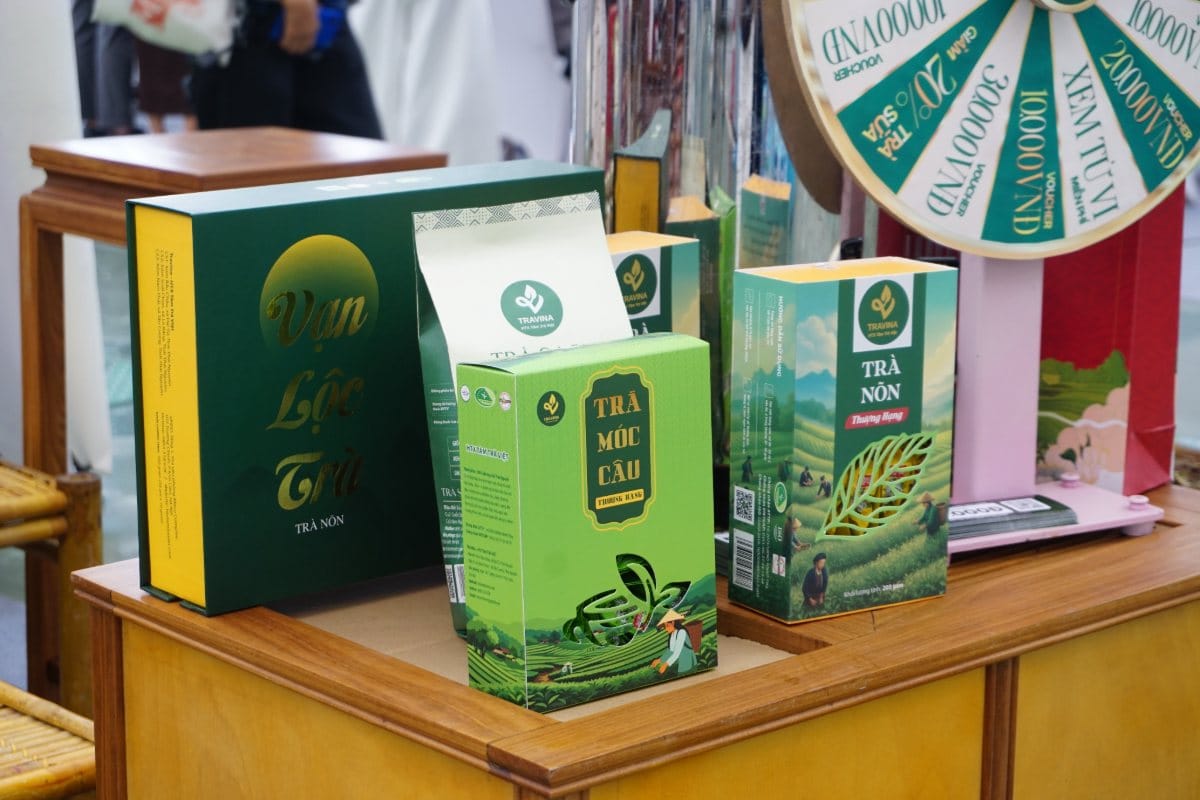
| Language and type size | Standard Chinese characters; any Vietnamese or English text no larger than the Chinese; mandatory text at least 1.8 mm high on packs whose largest surface is over 35 cm². | Designer |
| Claims | No health or function claims. From 2027, no “not added” or “zero added” wording. | Exporter and importer |
Imported packs may leave out the foreign producer’s own name, address and contact details (clause 4.1.6.3) and the product standard code (clause 4.1.10). SAMR Order 100 keeps these exemptions from 2027 and adds the food production licence number.
Dates: production date, shelf life and the 2027 expiry-date rule
Dates need the most care. Under GB 7718-2011 clause 4.1.7, the label shows a clear production date and shelf life, and dates must not be added later with a separate sticker, reprinted or altered. If the date is not in year-month-day order, the label must say which order it uses, so a Vietnamese pack printed 15/10/2026 needs a note or a change to 2026-10-15.
From 16 March 2027 the label shows an expiry date, written year-month-day. Products with a shelf life of six months or more may drop the production date. Dates sit in a separate area of the main display panel, at least 3.0 mm high (2.0 mm on packs under 35 cm²). Tea shipped in late 2026 may still be on Chinese shelves when the new rules start, so agree the date format with your importer now.
Language, type size and Chinese stickers
Mandatory content must be in standard Chinese characters. Vietnamese or English text may appear if it corresponds to the Chinese and is no larger, except for trademarks, the foreign producer’s name and address, and websites. Many exporters apply a Chinese sticker instead of printing a separate pack; ChemLinked’s summary of GB 7718-2025 describes the Chinese version as “either printed or affixed”. Keep the printed dates on the pack legible and consistent with the sticker.
Plain green tea has no added ingredients, so the 2027 allergen rule (gluten-containing cereals, crustaceans, fish, eggs, peanuts, soybeans, milk and tree nuts) should not add text, but blended or flavoured teas need a fresh check. Nutrition labelling falls under GB 28050, also revised in 2025 and effective 16 March 2027; confirm with your importer whether your product needs a nutrition panel before printing.
What customs checks and what the importer is responsible for
GACC Announcement No. 70 of 2019 ended label filing for first shipments from 1 October 2019. Importers now “bear the major responsibility for food label regulatory compliance prior to customs release”, in ChemLinked’s summary, and labels are checked during normal sampling. If a shipment is picked, the importer provides the certificate of conformity, the original label with its translation and a sample of the Chinese label. Products that fail may not be imported, and confirmed problems found after release lead to destruction or return.
Decree 249 adds record keeping. Importers keep import and sales records for at least six months after the shelf life ends (Article 21) and must review their overseas exporters and production facilities (Article 22). Article 98 of the Food Safety Law lists the batch number, dates, quantity and parties to record. Printing the batch number and matching dates on every carton makes that work easier for your importer.
Mistakes that send tea labels back
- Health or function claims. CIRS lists these on ordinary food as a common error. Keep them off both the Chinese label and the original pack.
- Foreign text larger than the Chinese. A big Vietnamese or English name above small Chinese text breaks the size rule.
- A name that hides what the product is. A brand name alone, without 绿茶 or a similar true name, does not meet clause 4.1.2.
- No Chinese importer details. The importer line is mandatory and has to come from the buyer before printing.
- Unclear date order. Day-month-year dates without a note on the order do not meet clause 4.1.7.3.
- “Zero added” wording on stock that will be sold after March 2027. GB 7718-2025 bans “not added” and “zero added” style claims.
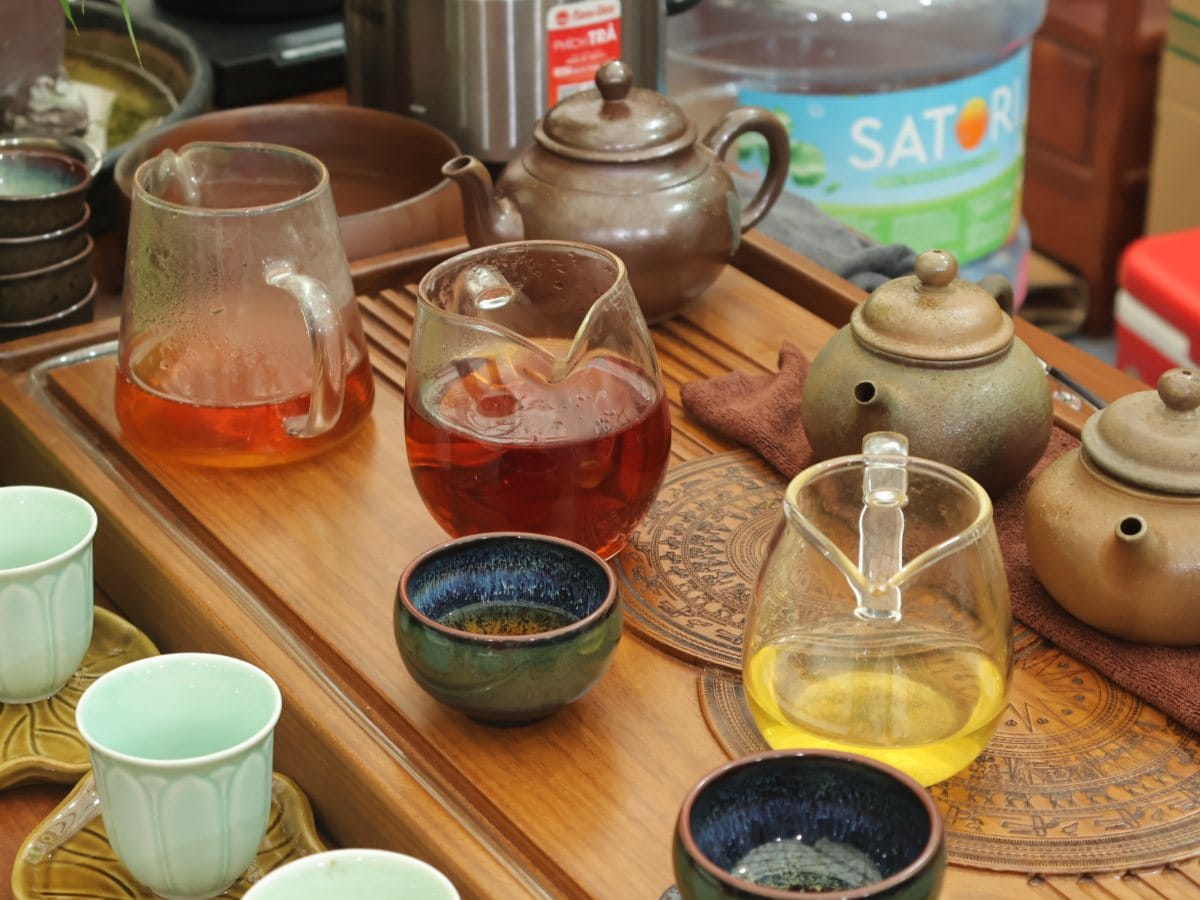
How TRAVINA prepares tea for Chinese buyers
TRAVINA – Tam Tra Viet Cooperative grows and processes tea in Dai Tu and La Bang, Thai Nguyen, Vietnam. Its 90 member households farm 40.5 ha and produce about 120 tonnes of dry tea a year. The processing facility at La Bang holds ISO 22000:2018 certification, and our certificates and licences page lists the documents available to buyers. As our Decree 280 guide explains, TRAVINA is not yet registered with GACC under its own name, so for general-trade shipments we work with importers and registered partners who handle the declaration.
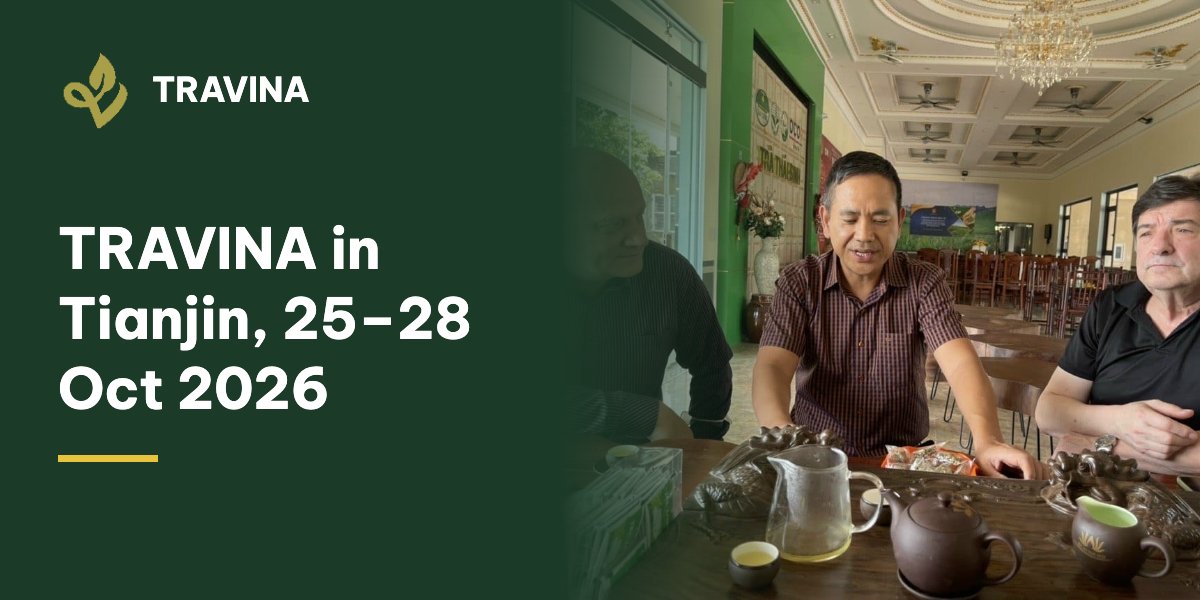
In practice, the Chinese label is drafted together with the buyer. We supply the Chinese food name, ingredient line, net content, storage conditions and date format. The importer adds its company name, address and contact details. Quotes are EXW in USD, and no minimum order is printed. Orders under 100 kg are dispatched within 24 hours, from 100 kg within 2 days, and from 1 tonne by agreement. For bulk and private-label options, see bulk tea export. Our founder will be at the Tianjin exhibition from 25 to 28 October 2026. Details are on TRAVINA in Tianjin, October 2026.
Frequently asked questions
Can the Chinese label be a sticker on the original Vietnamese pack?
Yes, the Chinese version can be printed or affixed, as long as it carries all mandatory information and meets the size rules. GB 7718-2011 does not allow dates to be added afterwards on a separate sticker, so keep printed dates clear and matching.
Whose name and address go on the label, the Vietnamese factory’s or the Chinese importer’s?
The label must show the name, address and contact details of the importer, agent or distributor registered in China, plus the country of origin. Under GB 7718-2011 clause 4.1.6.3, the imported pack may leave out the foreign producer’s own details.
What changes for tea labels in March 2027?
The main change is date marking: an expiry date in year-month-day order, in a separate area of the main panel. Minimum type sizes also rise on larger packs.
Does bulk tea in sacks need the full consumer label?
GB 7718-2011 clause 4.2 covers prepackaged food not supplied directly to consumers. Those labels must show the food name, specification, net content, production date, shelf life and storage conditions. Other content can go in the instructions or the contract instead.
Is label filing with customs still needed before the first shipment?
No. GACC Announcement No. 70 of 2019 cancelled label filing from 1 October 2019. The importer is responsible for compliance, and customs checks labels during sampling inspection.
Sources
- Pingdingshan Municipal People’s Government (official text), Food Safety Law of the People’s Republic of China, amended 29 April 2021: pds.gov.cn
- FAO FAOLEX, GB 7718-2011 National Food Safety Standard: General Standard for the Labelling of Prepackaged Foods, 20 April 2011: faolex.fao.org
- USDA Foreign Agricultural Service, China: Prepackaged Food Labeling Standards Finalized, 2025: fas.usda.gov
- ChemLinked, China Releases GB 7718-2025 General Standard for the Labeling of Prepackaged Foods, 27 March 2025: food.chemlinked.com
- Nanjing Administration for Market Regulation (official text), Measures for the Supervision and Administration of Food Labelling, SAMR Order No. 100, 14 March 2025: amr.nanjing.gov.cn
- Xinhua, SAMR food labelling measures to take effect with GB 7718-2025, 27 March 2025: news.cn
- REACH24H, Date marking: 9 changes in GB 7718-2025, updated 11 June 2026: en.reach24h.com
- Jinshan District CDC via The Paper, Interpretation of GB 28050-2025, 15 August 2025: m.thepaper.cn
- State Council Gazette, GACC Decree No. 280 on registration of overseas manufacturers of imported food, 14 October 2025: gov.cn
- Icelandic Food and Veterinary Authority (English translation), GACC Decree No. 249, Administrative Measures on Import and Export Food Safety, 12 April 2021: mast.is
- HKSAR Trade and Industry Department, GACC draft revision of the filing provisions for importers and exporters of imported food, March 2026: tid.gov.hk
- ChemLinked, China’s label filing for imported prepackaged food to be cancelled on 1 October 2019, 25 April 2019: food.chemlinked.com
- REACH24H, Mandatory filing procedure for labels of imported pre-packaged foods is cancelled, 2019 (updated 29 February 2020): en.reach24h.com
- CIRS Group, Label review and translation of prepackaged food, 14 June 2017: cirs-group.com
Planning a first shipment of Vietnamese tea to China? Send us your grade, pack size and importer details, and we will draft the Chinese label text with you. Contact TRAVINA