Vietnamese tea enters Indonesia through an Indonesian importer whose business identification number (NIB) also serves as its importer identification number (API). For retail packs, the importer registers each product with the food and drug authority BPOM, receives a “BPOM RI ML” number and needs a BPOM entry permit (SKI) for every shipment. The halal phase BPJPH set from 18 October 2026 covers imported food and beverages, with a pre-shipment check at the loading warehouse. Tea of Vietnamese origin can claim ATIGA preferential duty with an e-Form D.
| Step | Who handles it | What the exporter supplies |
|---|---|---|
| BPOM registration (ML number, 5 years) | Importer, distributor or local agent | Appointment letter, specification, label draft, samples |
| BPOM entry permit (SKI) | Importer, every shipment | Lot details; two-thirds of shelf life left at import |
| Halal assurance report (LPPH) | Importer and a BPJPH-designated inspection body | Halal certificate or registration number; warehouse access |
| Quarantine | Barantin | Prior notice, phytosanitary certificate, COA if the PSAT route applies |
| ATIGA preference | Importer’s customs broker | e-Form D |
| SNI for tea | Not found as mandatory | Confirm with BSN |
Who does what: the importer, BPOM and BPJPH
A Vietnamese exporter does not register products in Indonesia itself. BPOM Regulation 27/2017 defines the registrant as a company, such as an importer or distributor, or its authorised party, and the US Department of Agriculture (USDA) FAIRS report of 6 February 2026 says registration “should be undertaken by a local agent or importer”. The exporter supplies documents and samples that should pass review the first time.

Four bodies are involved: BPOM (pom.go.id), BPJPH (halal.go.id), the quarantine authority Barantin (karantinaindonesia.go.id) and customs, through the Indonesia National Single Window (SINSW, insw.go.id).
BPOM registration and the ML number
Under BPOM Regulation 27/2017, processed food imported for retail sale needs a distribution permit (izin edar). Imported products carry “BPOM RI ML” plus digits; local products carry “MD”. The permit lasts five years and is renewed by re-registration.
- The importer normally holds an appointment from the foreign manufacturer; losing it is a ground for revoking the permit.
- Raw materials, bulk goods not sold to consumers and small registration samples are exempt.
- The SKI is applied for at e-bpom.pom.go.id; USDA notes that imports must have at least two-thirds of their shelf life remaining.
Settle one classification question early. Indonesia also controls fresh food of plant origin (PSAT), and item 79 on the list of US products recognised under that system is “Green Tea and Black Tea”. Bulk leaf for repacking may follow the PSAT track instead; importers should confirm with BPOM and the National Food Agency (Bapanas).
Halal: what changed in October 2026
Government Regulation 42/2024, Article 160(3), required the obligation for foreign food and beverages to be set no later than 17 October 2026. In June 2026 BPJPH confirmed that the phase from 18 October 2026 covers imported products too. BPJPH Regulation 4/2026, promulgated on 10 August 2026, sets the import procedure:
- The importer applies through BPJPH’s electronic system and chooses a BPJPH-designated inspection body.
- The importer shows a halal certificate or halal registration number for the product.
- The inspection body verifies the goods at the loading warehouse before shipment and issues a halal product assurance report (LPPH).
- Each LPPH covers one shipment, must be held when the import declaration is filed, and is exchanged with SINSW.
Products from prohibited materials are exempt but must carry a non-halal statement. Materials listed in Ministry of Religious Affairs Decree 1360/2021 are also excluded, but tea is not named in the version we reviewed, so plan for certification unless BPJPH confirms otherwise. In September 2026 the trade minister said halal is not an import restriction: goods may enter but must be certified when circulated. BPJPH had mutual recognition agreements with 116 of 199 foreign halal bodies that applied; check that your certifier is recognised.

Labels in Bahasa Indonesia, and the SNI question
Retail imports must be labelled in Bahasa Indonesia at entry; USDA notes that stickers are allowed if applied before customs clearance and matching the BPOM-approved label. The label covers:
- product name, ingredients and net weight
- importer and manufacturer name and address
- production code and expiry date
- BPOM number
- halal logo where required, or a non-halal statement
USDA lists tea bags among products exempt from nutrition labelling. SNI 3836 is the national standard for packaged dried tea (teh kering dalam kemasan), but we did not find tea on the mandatory SNI list in the sources we could check, and in 2019 the Chamber of Commerce (Kadin) was still proposing mandatory SNI for tea. Importers should confirm with BSN (bsn.go.id).

Quarantine, documents and ATIGA duty
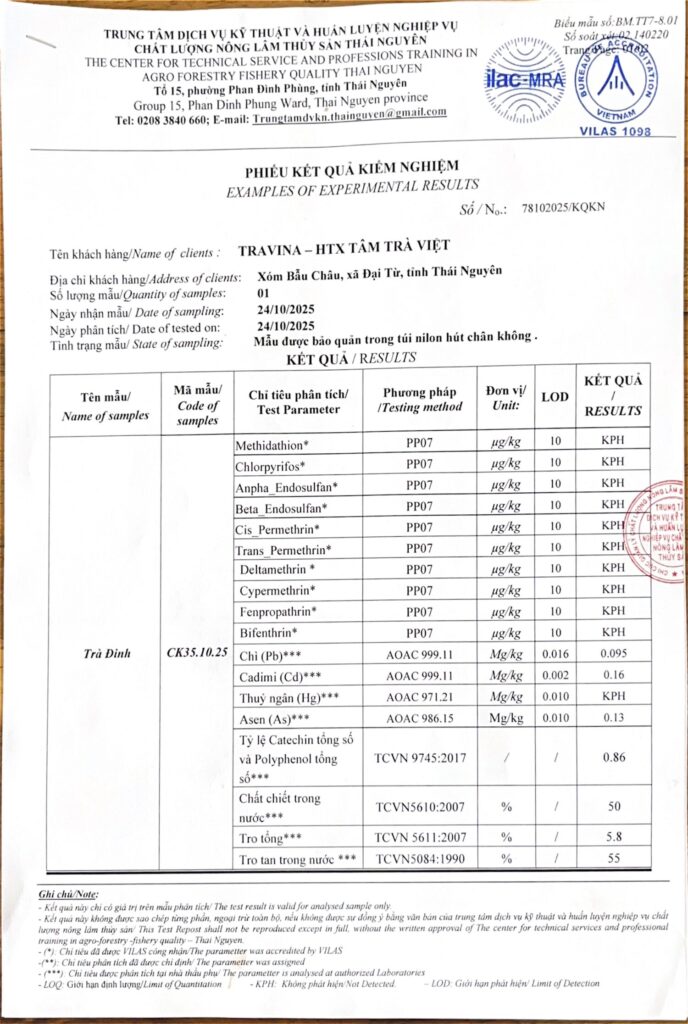
USDA’s export certificate report (February 2026) says Indonesia requires phytosanitary certificates for processed plant products, and IQA Regulation 9/2024 extends online prior notice to all plant products. For PSAT shipments, Vietnam’s Ministry of Industry and Trade reported in 2022 that the prior notice must name an Indonesia-approved Vietnamese laboratory and the certificate of analysis (COA) number. A typical file:
- commercial invoice, packing list, bill of lading or air waybill
- phytosanitary certificate from Vietnam’s plant protection authority
- COA from an approved laboratory, if the PSAT route applies
- e-Form D, exchanged by Vietnam and Indonesia via the ASEAN Single Window since January 2018
Indonesia sets its ATIGA rates in Minister of Finance Regulation 43/PMK.010/2022, in force since 1 April 2022. Check the rate for your 8-digit 0902 line on INSW or the ASEAN Tariff Finder before costing.
How TRAVINA works with Indonesian importers
TRAVINA is the brand of HTX Tâm Trà Việt, a tea cooperative in Đại Từ, Thái Nguyên, with 235 points of sale in Vietnam. Our raw material comes from a 40.5 ha area farmed under VietGAP procedures, and our La Bằng processing facility holds ISO 22000 certification. We supply Thai Nguyen green teas (Trà Bắc, Special Green Tea, Móc Câu, Nõn Tôm), Broken Needle Tea Bags and Núi Cốc black tea, with OEM/private label and gift box options.
- Specifications, lot samples and label artwork with space for Bahasa Indonesia text.
- Warehouse access for your inspection body’s pre-shipment check.
- In-stock products need no deposit; OEM orders from VND 20,000,000 carry a 20–30% deposit; any order with a printed logo carries 50%. Orders under 100 kg ship from our warehouse within 24 hours.
- Prices are quoted per order on request.
For tasting, brew Traditional Northern Green Tea at 5–7 g per 200 ml, 80–85°C.
Preparing a first tea shipment to Jakarta or Surabaya. Importers can request samples of Traditional Northern Green Tea, Special Green Tea or Broken Needle Tea Bags through our Contact page, or message our export team on Zalo/WhatsApp at +84 855 318 678. Send us your importer’s BPOM and halal checklist and we will prepare specifications and label drafts with your samples.
FAQ
Who registers Vietnamese tea with BPOM?
The Indonesian importer, distributor or its authorised agent.
Does green tea need a halal certificate in Indonesia?
Imported beverages fall under the phase from 18 October 2026 and tea is not on the exemption list we reviewed; confirm with BPJPH.
What is an LPPH?
A halal product assurance report from a BPJPH-designated inspection body, issued after checking goods at the loading warehouse, for one shipment.
Is SNI certification mandatory for tea?
We found no source placing SNI 3836 on the mandatory list; importers should confirm with BSN.
Sources
- BPJPH: halal deadlines and foreign products (PP 42/2024, Art. 160) – 23 Oct 2024
- BPJPH: products subject to mandatory halal from 18 October 2026 – 5 Jun 2026
- BPJPH Regulation 4/2026 (text) – promulgated 10 Aug 2026, accessed 9 Nov 2026
- ANTARA: imported products can still enter ahead of the halal obligation – 17 Sep 2026
- BPJPH: materials exempted from halal certification (KMA 1360/2021) – 1 Jun 2024
- USDA FAS GAIN ID2025-0054: FAIRS Country Report – Indonesia – 6 Feb 2026
- USDA FAS GAIN ID2025-0055: FAIRS Export Certificate Report – Indonesia – 6 Feb 2026
- BPOM Regulation 27/2017 on processed food registration (text) – accessed 9 Nov 2026
- Viet Nam Ministry of Industry and Trade: Indonesia prior notice for fresh food of plant origin – 31 Mar 2022
- ASEAN Single Window: ATIGA e-Form D exchange – 30 Dec 2019
- Minister of Finance Regulation 43/PMK.010/2022 (ATIGA duty rates) – 30 Mar 2022
- Kontan: Kadin proposals on tea import duty and non-tariff measures – 13 Mar 2019